

The semiconductor industry is expected to continue growing strongly in 2025, despite uncertainties surrounding US President Donald Trump’s trade policy, thanks to the AI boom. The World Semiconductor Trade Statistics organisation (WSTS) recently raised its growth forecasts for this year slightly. They’re now expecting growth of nearly 15 per cent for the current year, with a global market volume of USD 728bn (source: Erste Asset Management GmbH).
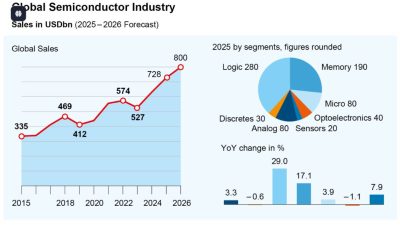 For the first half of 2025, the WSTS calculates a volume of USD 346bn. This corresponds to an increase of just under 19 per cent year-on-year. According to the WSTS, the primary growth drivers were logic and memory chips, with increases of 37 and 20 per cent, respectively. These segments were driven by strong demand from AI data centres and new AI applications, the organization reports.
A number of leading semiconductor companies have also recently reported strong quarterly figures and raised their forecasts for this year. For example, the world’s largest chip contract manufacturer, TSMC, continued to benefit from growing demand for AI chips and recently reported the best quarterly results in its history. TSMC’s revenue grew rapidly by 40 per cent to the equivalent of nearly EUR 27bn, while the group’s net profit rose by 60 per cent to EUR 11.6bn in Q2. The Taiwanese company said that there is no end in sight to this development. TSMC has forecast another jump in revenue for the current quarter.
Thanks to the leading role of its technology companies in this field, Taiwan is one of the main beneficiaries of the booming demand for AI chips. The country’s economy grew by 8 per cent year-on-year in Q2. This is its strongest growth in four years. However, advance orders are also likely to have played a role in view of the impending US tariffs. Despite the tariffs, Taiwan’s Department of Statistics expects demand to remain strong and recently raised its growth forecast for 2025 from 3.1 to 4.45 per cent.
However, American and European companies will also likely continue to benefit from the AI trend. AMD expects sales to exceed the latest analyst estimates thanks to strong demand for its AI chips. The California-based chip manufacturer recently forecast revenues of around USD 8.7bn for Q3, benefiting from cloud providers such as Microsoft and Meta increasing their investments in AI infrastructure.
German semiconductor manufacturer Infineon earned significantly less in the past quarter, but is also looking into the future with greater confidence. Dutch industry peer ASML, on the other hand, was more cautious in its outlook despite positive figures and booming demand for AI chips. ASML CEO Christophe Fouquet spoke of “increasing uncertainty due to macroeconomic and geopolitical developments.”
The major uncertainty factor for the industry remains the tariff policy of US President Donald Trump. In the coming weeks, Trump wants to impose new tariffs on semiconductor chips in order to bring a larger share of chip manufacturing back to the US. “I’ll be setting tariffs next week and the week after on steel and on, I would say, chips,” Trump told reporters aboard Air Force One last week. The tariffs would be lower at first to allow companies to set up manufacturing in the US. They would rise later, the Republican president added, without giving specific figures. Shortly before that, Trump had already announced plans to impose tariffs of 100 per cent on semiconductor products. Trump expressed confidence that companies would choose to manufacture in the US rather than pay high tariffs.
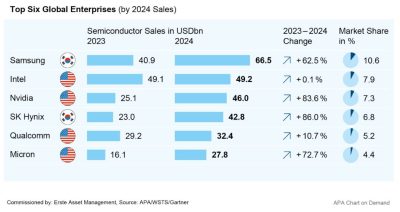 In response to the US tariffs, international semiconductor companies have already begun to scale back investments in facilities outside the US and plan manufacturing sites in the US. According to media reports, TSMC has delayed the construction of a plant in Japan in favour of a new facility in the US.
However, Trump not only wants to impose higher tariffs on international companies, but also to support the domestic chip industry in return. According to a media report, the US government is considering investing in the struggling US company Intel. President Donald Trump’s administration is holding talks to this effect, the Bloomberg news agency reported last week, citing well-informed sources. However, there has been no official statement from Intel or the US government as yet.
Exports of AI chips from the US to China are also a thorn in Trump’s side. In order to slow down China’s technological and military rise, the US has already imposed increasingly strict restrictions on exports of high technology to the country under Trump’s predecessor Joe Biden.
US industry leader Nvidia responded by developing new, scaled-down versions of its AI chips, but even these eventually fell under Trump’s export restrictions. Nvidia itself estimated the resulting loss of revenue at USD 15bn. However, the US president recently did not rule out allowing Nvidia to resume sales of the less powerful AI chips to China. The Trump administration had previously confirmed an agreement with Nvidia and AMD under which the US government would receive 15 per cent of the revenue from sales of certain advanced chips in China.


COMMENTS